

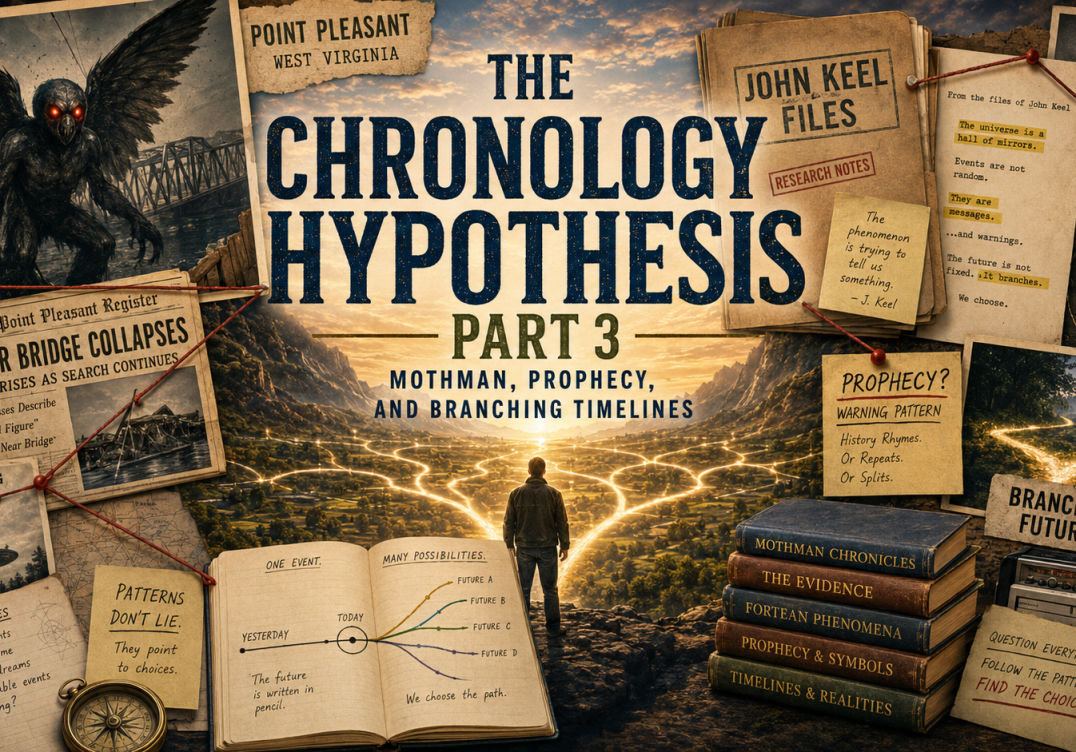
A particularly striking feature of the Chronology Hypothesis is that it doesn’t rest on a single remarkable UFO incident, nor on one exceptional witness, or even on one specific area of anomalous research. Rather, its significance comes from the fact that certain themes have reappeared again and again in more than seventy years of contactee literature, UFO reports, alleged abduction experiences, Men in Black encounters, paranormal investigations, and accounts of apparent precognition. Although many of these stories appear to belong to entirely different categories when looked at separately, an interesting common element starts to become apparent when they are compared with one another.
That thread represents humanity’s relationship with catastrophe—especially catastrophes caused by humanity itself.
The idea is already present at the very start of the modern UFO era. In the 1950s, the contactees often stated that their visitors were worried about atomic weapons, warfare, environmental destruction, and the fact that humanity seemed unable to match its technological progress with moral maturity. Whether or not one accepts those assertions, the message had become an integral part of UFO culture very early on. The alien visitor was not merely an explorer coming from another planet; he was usually depicted as a messenger standing by humanity at a crossroads.
As the phenomenon changed, the message remained.
The Space Brothers, who had been friendly, mostly vanished. The abduction stories grew more sinister. The creatures altered. The situations altered. The psychological atmosphere also changed.
But the warnings remained.
It is particularly interesting to consider that continuity when we go beyond ordinary UFO literature and enter the kind of territory investigated by John A. Keel.
The most well-known example is The Mothman Prophecies. It is understandable that popular culture has distilled the story down to its most dramatic aspects: the red-eyed creature said to have been seen near Point Pleasant, West Virginia, and the tragic failure of the Silver Bridge on December 15, 1967. Keel’s investigation was, in fact, much stranger than the version that is generally known.
The Mothman played a nearly unimportant role in the bigger mystery.
Keel found himself recording cases of UFOs, strange lights, odd telephone calls, encounters with the Men in Black, apparent coincidences, unusual visitors, prophetic dreams, cryptic warnings, and individuals who claimed to have received impressions of events which had not yet happened. The more deeply Keel delved into the mystery, the less it seemed to be merely a story concerning an unknown animal or an extraterrestrial spacecraft; it started to appear rather as a subtle phenomenon capable of interacting with human perception.
Keel is especially relevant to the Chronology Hypothesis at this point.
Keel had a great deal of suspicion about taking statements literally. He knew that any apparently prophetic information resulting from abnormal encounters was generally unreliable, distorted, incomplete, or expressed in symbolic form. A witness could be given something that looked like an urgent warning concerning a disaster only for the predicted event to fail to take place. In other cases, a prediction might at first appear to be wrong but later on would in surprising ways resemble what actually happened. The phenomenon appeared to be able to generate information which wavered uncomfortably between prophecy, coincidence, deception, and true foreknowledge.
This is very frustrating for a researcher who is looking for certainty.
If the future were a fixed destination, prophetic information should in theory be simple. Event A will take place at location B on date C. It either happens or it doesn’t.
What if the future is not fixed?
Let us imagine that history is like a tree whose branches keep splitting as choices are made. From our position within the tree, we can only experience the branch that we are on. We have one past and meet one present; the other possible outcomes vanish from our experience as the events progress.
A creature that could see that tree in a different way might have a completely different experience of reality; what seems to us to be prophecy might, in its case, simply be probability.
That possibility brings us forward several decades to the cases discussed by investigator Nick Redfern in Top Secret Alien Abduction Files. Redfern documents accounts from alleged abductees and experiencers who claimed that their encounters included disturbing visions of humanity’s possible future. As with the experiences described in Keel’s work, these were not necessarily orderly presentations of future history. They were frequently fragmented, emotional, dreamlike, and apocalyptic.
Witnesses described ruined cities.
Environmental devastation. Societal breakdown. Military conflict.
And, repeatedly, nuclear war. Of the various accounts that Redfern examines, he mentions reports of visions concerning North Korea and a catastrophic nuclear exchange. The importance of these accounts in the context of the present discussion is not that they predict what North Korea will do; they do not. They also should not be regarded as intelligence evaluations disguised as paranormal evidence; rather, they are descriptions given by the people who had the experiences of what they believed themselves to have seen in those unusual states or encounters.
In fact, that distinction makes them more interesting in the context of the Chronology Hypothesis.
The value of such prophecies, if they were ordinary ones, would be determined by whether the events in question took place.
What if they weren’t prophecies?
What if these were possibilities?
Think about the way modern weather forecasting functions. If a hurricane develops over warm ocean water, meteorologists do not usually give it a single fixed path. Instead, computer models produce a number of possible tracks, some of which predict landfall at distances hundreds of miles apart. The probabilities are subject to change as more information becomes available. A course that seemed likely on Monday can turn out to be unlikely by Wednesday.
It is not the case that people conclude that the model on Monday somehow lied.
The conditions have changed.
Now picture history working on the basis of something roughly similar—not in a meteorological way, of course, but in a probabilistic way.
A nuclear war scenario involving North Korea could therefore be seen as one of the possible developments that is observable at a given time, rather than as a predestined event in history. Political decisions do change. Governments come and go. Leaders die off. Treaties are either signed or discarded. New technologies appear. Accidents are prevented. Intelligence operations either succeed or fail. A single decision taken in a command post may affect the lives of millions of people who will never know that the decision had been made.
The future moves.
Hence, within the Chronology Hypothesis, the most interesting prophetic vision might in fact be the one which never comes about.
It is problematic when a prediction fails.
A warning that, directly or indirectly, helps to avoid the predicted outcome is quite a different thing.
There is no proof that the North Korean scenarios mentioned in these experiencer accounts had an impact on government policy, and the hypothesis doesn’t depend on that assumption; rather, their significance lies in the imagery which recurs. Throughout the various generations of anomalous literature, humans have on numerous occasions come across visions in which nuclear technology becomes the point about which history turns.
And that leads us to the present day.
A definite change took place in the public discussion of UFOs from the late 1940’s. Throughout the postwar era, the subject remained in a most unusual cultural position. Soldiers kept on reporting strange objects, researchers investigated them, governments examined them from time to time, and the public stayed deeply interested. But there was an outstanding stigma attached to any serious talk about UFOs. Pilots were concerned about their careers, scientists generally shied away from the topic, and politicians only mentioned it occasionally and in a humorous way.
Then the vocabulary changed.
“UFO” increasingly became “UAP”. Mainstream reporting began to cover military encounters more intensely.
The U.S. Navy has officially confirmed that the now well-known FLIR1, Gimbal, and GoFast videos are real recordings of unidentified phenomena from the military. While the Trump administration has been in office, the subject gained a great deal of institutional recognition, leading to the establishment of the Unidentified Aerial Phenomena Task Force and to congressional demands that eventually forced the intelligence agencies to give assessments to members of Congress regarding what the government knew about UAP encounters.
The fact that the government admitted some military encounters had not been identified is completely different from stating that spacecraft of extraterrestrial origin had been discovered. These two statements are often mistakenly regarded as being the same in public debate.
They are in no way the same.
Yet the cultural shift was remarkable. In that a topic which had for many decades moved around in the wilderness area lying between folklore and national-security secrecy was now being talked about by senators, intelligence officials, naval aviators, representatives of the Pentagon, and the major news agencies. It follows that the transformation set out in the original Chronology Hypothesis is mainly a cultural one since the modern UAP era has produced a setting in which questions once regarded as almost professionally off-limits can again be asked seriously.
When he left office, former President Barack Obama created another remarkable instance by publicly stating that there are recordings and records of objects in the sky whose movements and nature are still unexplained. In making these comments, he was careful. He did not declare that there had been visits from extraterrestrials, and he did not identify the objects. In some ways, this caution made the statement more significant since a former American president had admitted that the unexplained phenomena themselves were real.
The variety of interpretations has become even greater since then.
A number of people consider UAPs mainly to be a question of national security. Others see them as a scientific issue. Some researchers still prefer the idea that they come from outer space. However, others—those who follow people like Jacques Vallée and John Keel—doubt whether the term “extraterrestrial” is too narrow a category.
There are also outright theological explanations. Vice President J.D. Vance has expressed his fascination with UFOs at public events while stating his personal conviction that the phenomenon should be understood in terms of demons rather than extraterrestrial origins. As to whether that interpretation is valid—since it certainly merits a completely separate discussion—it shows an important aspect of the UFO enigma.
The phenomenon works almost like a mirror.
The physicist comes across a physical system which cannot be explained.
He observes a possible threat which has not been identified.
The psychologist observes altered states, memory, archetypes, and perception.
The theologian recognizes the possibility of spiritual intelligence.
The conventional ufologist regards extraterrestrial visitors.
The model proposed by Vallée allows for something that is interdimensional or culturally adaptive.
His thoughts seem to lead in a direction that is even more strange.
The Chronology Hypothesis also raises the question of whether we have completely overlooked another possibility.
Time.
Perhaps the issue isn’t just where these intelligences come from, but when—or indeed the concept of ‘when’ has the same meaning for them as it does for us?
The discussion is thus brought once again to the Men in Black.
Many other writers besides Keel, Redfern, and Gray Barker have recorded accounts of mysterious figures appearing near UFO witnesses. Although popular culture has since turned these figures into government agents, a great many of the original descriptions are in fact much stranger. The witnesses have described figures who looked artificial, were socially clumsy, were strangely dressed, or knew things in an inexplicable manner. In some cases, the figures seemed to know details which they should not have reasonably been expected to know. In others, they appeared to be more interested in confusing the witnesses than in silencing them.
The Chronology Hypothesis provides an intentionally speculative reinterpretation.
Perhaps the purpose is not secrecy but uncertainty?
If history is made up of a number of different possible paths, then having complete knowledge of future events could in fact change those events. Whenever someone acquires such information, they become a part of the system which is being predicted. If you tell someone exactly what is going to happen tomorrow, that person might then behave in a different way today.
In that respect, uncertainty would then be no defect.
It would be necessary.
The unexpected function of the combination of warning and confusion that is widespread in anomalous literature might well be to offer just enough information to affect people’s decisions without giving enough certainty to remove the uncertainties.
This is where the Chronology Hypothesis differs from conspiracy theory. It does not require government coordination.
It doesn’t need secret knowledge of the President.
It is not necessary for all UFO reports to be genuine.
It doesn’t even necessitate that the phenomenon be extraterrestrial.
Rather, it poses the question of whether various independent streams of human experience have on numerous occasions come to the same conclusion. One of the streams is traditional. Governments are concerned about nuclear proliferation since nuclear weapons are capable of destroying cities, causing national instability, leading to arms races, and possibly having civilization-altering effects. There is another stream that is abnormal. For seventy years, UFO contactees, abductees, people who have had paranormal experiences, and investigators have on numerous occasions come across images relating to nuclear weapons, environmental disaster, and the possibility of humanity’s destruction or possible destruction.
There are completely normal explanations for that similarity.
Nuclear war is one of humanity’s oldest and most profound modern fears and is therefore found in dreams, in literature, in cinema, in political discussions, in religious beliefs, and in paranormal stories. Just because a more unusual explanation is exciting does not mean that a psychological one can be ignored.
However, caution in matters of intellect has a double effect.
Recurrence should not automatically cease to have meaning.
It is exactly because we do not yet know what they mean that certain patterns warrant being examined.
Those possibilities are still completely possible.
Maybe certain experiences involve coming across probabilities rather than predictions.
It is possible that some witnesses see histories that might occur rather than those that must occur.
It is not necessarily the case that catastrophic futures which do not occur are failed prophecies.
Maybe the roads are those that humanity never took.
It cannot at present be shown and might never be provable.
Yet as a philosophical framework, it produces an intriguing reversal of the traditional UFO question.
For generations we have looked upward and asked:
Where are they from?
The Chronology Hypothesis suggests another question.
What if “where” was never the mystery?
What if the phenomenon’s persistent concern with nuclear technology, catastrophe, human choice, and unrealized futures has been pointing toward a different dimension of the problem all along?
Not space.
Time.
And if so, perhaps the most haunting possibility raised by the UFO mystery is not that something has traveled an unimaginable distance to reach us.
Perhaps it is that somewhere—within some branch of possibility—the future has already seen what happens when humanity makes the wrong choice.
And perhaps some of those futures have been trying, however imperfectly, to make themselves impossible.


Comments