

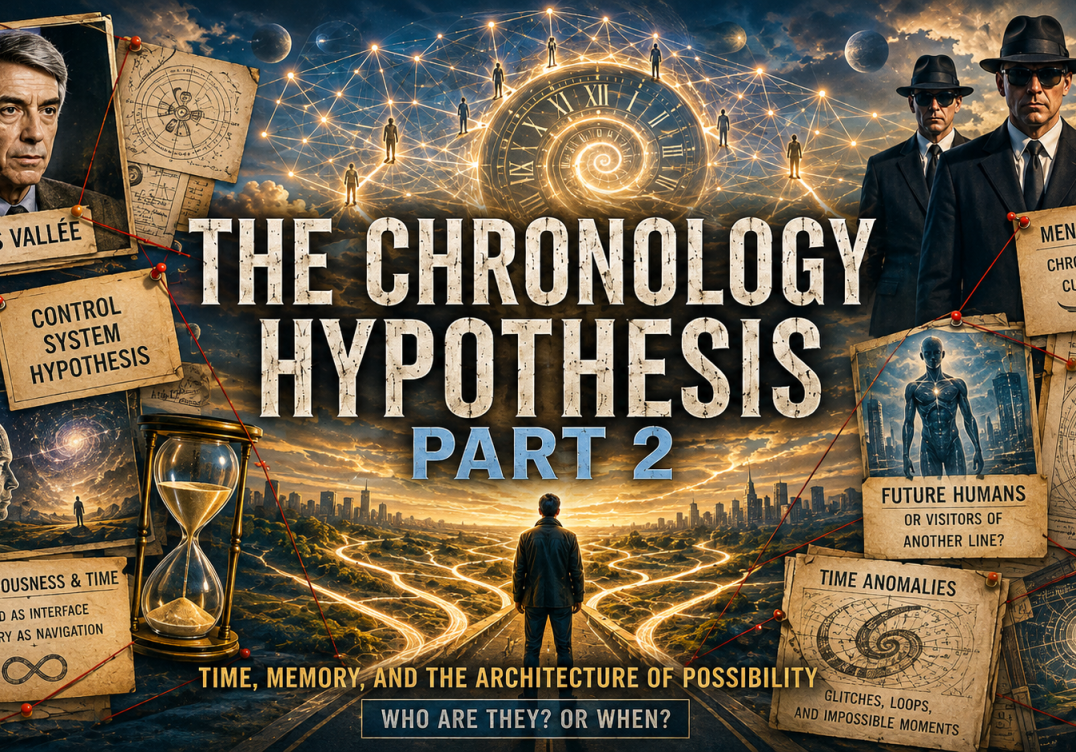
Time, Memory, and the Architecture of Possibility
The only philosophical basis of the Chronology Hypothesis is this idea that the phenomenon might not be encouraging humanity to look further into space but rather deeper into time.
This idea is by no means particular to the study of UFOs. Modern physics has on several occasions undermined the common conception of time as a straightforward flow from the past into the future. As per Einstein’s theory of relativity, time is not an absolute background upon which events take place, but a dimension closely linked with space itself; time can slow down, different observers can dispute the order of events, and the universe is therefore much stranger than our everyday experience would lead us to believe.
The Chronology Hypothesis doesn’t try to use physics as evidence; instead, it draws on the nature of those discoveries. Since our scientific understanding of time has changed dramatically in the last century, it’s possible that our assumptions regarding consciousness and chronology should also be accompanied by a similar feeling of humility.
A few physicists have investigated the concept of the “block universe”, according to which the past, the present and the future all exist within a 4D spacetime. Some have also studied the mathematics of closed time-like curves or the various quantum interpretations which allow for branching possibilities. However, none of these theories prove that UFO encounters are real. Nevertheless, they serve to remind us that time is still one of the most unintuitive features of the cosmos.
Let us imagine, for the sake of speculation, that there are kinds of intelligence which do not experience time in a sequential manner. For such beings, history may be like a complex landscape rather than a pathway. Human civilization would not seem like a single line extending into the future, but rather as a living network of possibilities which are always branching out and coming together.
In that framework, the concept of intervention would become completely different.
Rather than making a dramatic entrance to take over Earth or appearing openly, such intelligences could influence history in an exceptionally subtle way—for example, by affecting a single dream, causing a symbolic vision, leading to an inexplicable meeting, or by having a conversation that is remembered for decades. They might introduce small disturbances at times when civilization is approaching critical decisions.
The course of history would not be altered by armies.
It would be nudged.
Vallée’s Control System Revisited
No thinker has questioned traditional ideas concerning extraterrestrial life more deeply than Jacques Vallée. In books like Passport to Magonia, Messengers of Deception, and Dimensions, Vallée maintained that the UFO phenomenon is more like an adaptive intelligence interacting with human consciousness than to visitors from another solar system.
His well-known “control system” hypothesis is still one of the most provocative ideas in the study of UFOs.
Instead of showing itself directly, Vallée suggested that the phenomenon could have an effect on belief, myth, and culture throughout a long span of history; for example, medieval encounters with angels and fairies, the airship waves of the nineteenth century, the flying saucers of the twentieth century, and modern abduction experiences might all be considered as culturally adapted forms of the same basic intelligence.
The Chronology Hypothesis doesn’t take the place of Vallée’s model.
It extends it.
Perhaps the control system is not simply affecting beliefs?
Perhaps it is affecting chronology?
From this point of view, mythology functions as a mechanism rather than as a byproduct. The stories themselves subtly change human perception. Ideas become more widespread. People’s priorities alter, and they then make different choices. The future is not brought about by dramatic interference but by the combined effect of millions of apparently insignificant decisions.
A process of this kind would account for one of the most puzzling features of UFO encounters: their continuous ambiguity.
It rarely offers universally verifiable proof.
Instead, it leaves impressions.
Questions.
Symbols.
Fragments.
It is sufficient to encourage thought, but seldom enough to remove uncertainty.
It is possible that a sense of certainty might diminish the freedom which the phenomenon is aiming to keep.
The Men in Black as Chronological Custodians
Of all the figures in the subject of UFOs, the Men in Black are perhaps the strangest.
They have been transformed by popular culture into government agents who are impeccably dressed, equipped with cutting-edge technology, and possess a dry sense of humor. The original reports, on the other hand, tell a completely different story.
Accounts were gathered by authors such as John Keel, Gray Barker, and later Nick Redfern, in which these mysterious visitors frequently acted in ways that went against what one would normally expect from a human. The witnesses said that the men had clothing which looked strangely out of date, their manner of speaking seemed as though they had been rehearsed, their emotional reactions appeared to be artificial, and their knowledge of ordinary social behavior was strangely incomplete.
There were some cases in which people had odd physical features. In other instances, they showed knowledge which they apparently shouldn’t have. And a small number seemed to turn up without any obvious way of getting there before vanishing just as mysteriously.
Several researchers saw these accounts as proof of secret government agents, while others believed the people in question to be extraterrestrial imitations, and a further group thought that they were examples of folklore which had been enlarged through imagination.
The Chronology Hypothesis offers another possibility not since the evidence requires it, but because the reports suggest a creative examination.
Let us assume that the Men in Black are neither government officials nor extraterrestrials.
Imagine that they are the guardians of chronology.
What they would aim at is not the suppression of knowledge on grounds of national security, but rather the stability of history itself.
People who had particularly important encounters might accidentally act as divergence points in the timeline, and information that was made public too early—misunderstood—could affect decisions, the consequences of which spread over generations.
In this situation, the Men in Black are more in the role of archivists than that of police officers. Their function is one of maintenance as opposed to domination, and their rather clumsy behavior might in fact indicate the difficulties of operating in a historical era to which they do not naturally belong.
It is still entirely speculative whether such beings would arise in humanity’s distant future from parallel histories or from an intelligence that exists outside ordinary chronology.
But when this perspective is applied, the long-standing mystery of the Men in Black turns out to be surprisingly clear. Their actions appear irrational when evaluated in the light of espionage, whereas they become much more comprehensible when assessed in terms of chronology.
Memory as a Window Through Time
The most interesting aspect of the Chronology Hypothesis is memory.
For a long time, abductees have observed that they often describe their encounters as if they were both remembered and dreamed. The details come slowly and are usually accompanied by emotional certainty which goes beyond their objective clarity. It is difficult for the witnesses to account for the fact that the experience seems completely real even though it has dreamlike characteristics.
Maybe memory isn’t always a backward-looking thing?
The idea seems quite radical at first, but it can be understood when one remembers that anticipation has a way of influencing human consciousness. Before their performances, athletes mentally go through what they will do. Musicians hear their compositions in their minds before playing them. Engineers picture bridges well before any steel is put in place. Writers also experience scenes as if they were recalling stories which they have not yet finished.
Consciousness flows easily from memory into imagination.
The Chronology Hypothesis simply inquires if, in rare and not well understood situations, consciousness might also become sensitive to future probabilities.
Not fixed futures.
Potential ones.
If that is the case, a great many anomalous experiences might be the mind’s attempt to express information about which ordinary language has no vocabulary; nuclear explosions then take the form of symbols, uninhabited cities become emotional impressions, and strange beings act as interpreters between incompatible ways of perceiving reality.
It is still unknown whether those interpreters are external intelligences, manifestations of the unconscious, or a thing that goes beyond both of those categories.
Maybe the distinction is merely artificial.
A Different Question
Throughout the modern UFO era, researchers have always asked the same question.
Who are they?
It’s a natural question—if such odd aircraft exist, then working out where they come from should obviously be the aim.
But even after almost eighty years, clear answers are still hard to find.
The Chronology Hypothesis implies that maybe the question we have been asking is incomplete.
Rather than merely asking who, we could also ask when.
If the phenomenon is essentially temporal, not spatial, many of its long-standing mysteries take on a different aspect; its ambiguity can then be understood, its symbolic form of communication becomes practical, and its repeated focus on existential risks appears logical. Most importantly, its continual refusal to provide definite proof starts to look like restraint rather than a lack of ability.
It makes very little difference whether this conjectural framework ultimately turns out to be insightful or completely wrong.
The value of it is in prompting us to look at well-known reports from a different point of view.
For seventy years, ufology has mainly searched the skies.
It is possible that the next major step forward in our knowledge won’t result from exploring further into outer space.
It might arise from a new way of thinking about time itself.


Comments