

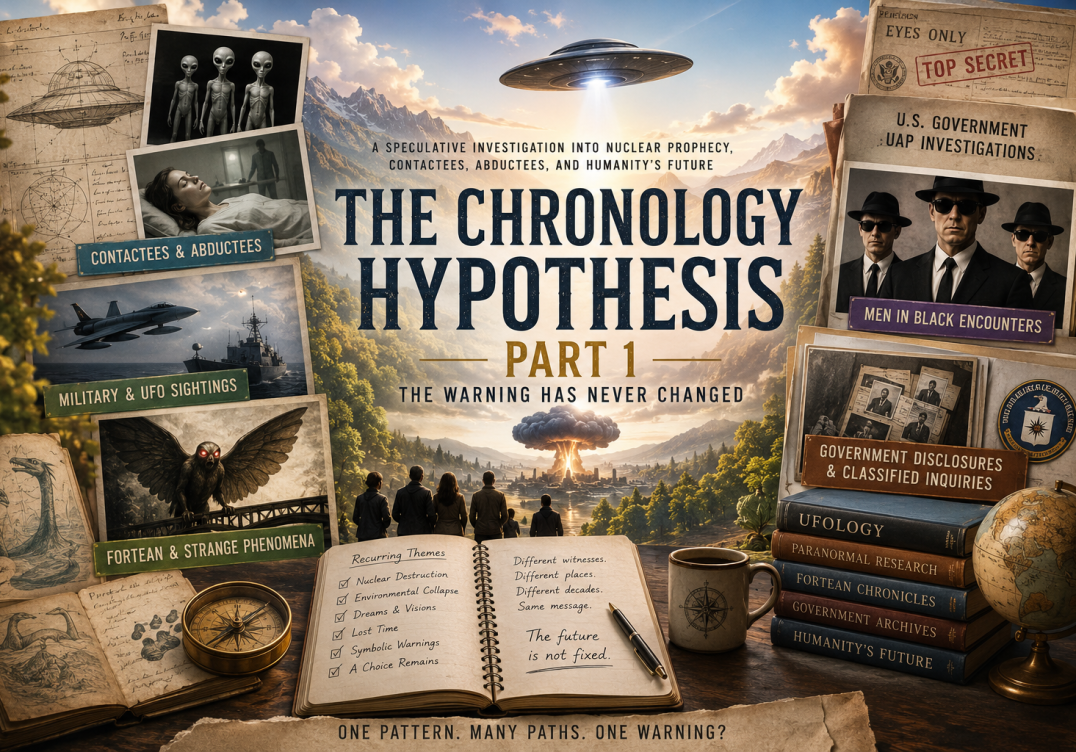
All the different areas of anomalous research have their own specialists. UFO researchers concentrate on contactees, abductees, and sightings by the military. Fortean researchers investigate reports of odd creatures like Mothman. Paranormal investigators keep records of encounters with the so-called “Men in Black”. Historians who study intelligence agencies investigate government disclosures and classified inquiries that have taken place over many decades. Each of these fields has built up its own body of literature, a particular vocabulary, and a set of assumptions. They seldom come together.
This separation could be a serious mistake.
It is worth thinking about the possibility that these phenomena are not separate mysteries but instead various expressions of a single fundamental intelligence, an intelligence which has taken over seventy years to try to send humanity a unified warning.
Even though this possibility may seem extraordinary, there is another equally remarkable observation. Since the modern UFO era began in the late 1940s and early 1950s, one topic has appeared with great persistence, no matter who the witness was, what country they were in, or what kind of encounter it was.
Nuclear destruction.
It is not true that all witnesses mention this theme or that every case has a prophetic aspect. On the other hand, when the broader historical context is taken into account rather than looking at the individual reports, the recurrence can hardly be ignored. Although the identities of the visitors vary, the descriptions of the craft change and the cultural background moves from the optimism of the Space Age to the fears of the Information Age. Yet the warning itself remains remarkably consistent.
The first clues come from early contactee literature.
In the 1950s, people who claimed to have had face-to-face meetings with benevolent extraterrestrials usually spoke about the future of humanity. Nowadays many researchers disregard these accounts on the grounds that the claims seem impossible by today’s standards. Yet even those who cast doubt on the literal details often admit to the consistency of the main message.
From one witness to another, it was claimed that people had entered a dangerous new age. The detonation of the atomic weapons, it was said, was more than just a technological achievement; it was a turning point in human history.
It really doesn’t matter if one believes those stories.
A striking feature is the fact that a great many separate narratives all come to focus on the same central issue.
Over the years that followed, the phenomenon seemed to change. Around the end of the 1970s and during the 1980s, the optimistic ‘Space Brothers’ of the contactee period had mostly disappeared from UFO literature and were replaced by accounts of lost time, mysterious medical examinations, enigmatic symbols, and very personal abduction experiences.
The atmosphere had changed considerably.
The method of communication was just as such.
Instead of having long philosophical discussions, many abductees described seeing dreams or experiencing visions. These visions were usually highly symbolic and not intended to teach a lesson. Typical images were cities on fire under overcast skies, dead forests, rising oceans, crops that had failed, and families looking for one another in the face of catastrophic scenery. The images most often reported were bright flashes, mushroom clouds, and the clear aftermath of a nuclear war.
Psychologists have put forward reasonable explanations for these experiences, stating that they might be manifestations of cultural anxieties, subconscious symbolism, or trauma worked through in dreams. These explanations merit serious consideration; at the same time, it is just as important to point out that people from different countries, various social backgrounds, and different time periods have often described very similar images even though they had no obvious links with each other.
Might this just be a coincidence?
Certainly.
Might it represent the fears that are common to all humans?
Perhaps.
It is worth considering another possibility, not because it has been confirmed by observation, but because it offers an interesting framework through which many reports that would otherwise appear unrelated can be seen as part of a broader pattern.
Let us assume that these visions are not predictions.
Suppose they are possibilities.
Modern physics includes ideas which challenge the usual way of thinking about time. It is possible to imagine an intelligence that does not see time as a straight sequence but rather experiences many possible futures at the same time. This kind of intelligence would not have to predict a single tomorrow, but could instead watch over numerous possible futures, all of which arise from decisions that humanity has not yet made.
From this point of view, the nuclear visions which are repeatedly reported by the experiencers take on quite different meaning; instead of being seen as fixed prophecies they can be understood as warnings coming from futures which are still avoidable.
This explanation immediately brings up one of the oldest questions in the study of UFOs.
What reason would there be for a highly developed intelligence, if it really wanted to prevent disaster, to use ordinary people as its means of communication?
Why not world leaders?
Why not military commanders?
Shouldn’t the scientists who are designing the technologies that shape civilization be?
It is a sensible question, though it could imply that direct intervention is the most effective way of affecting historical outcomes.
Another possibility is to view history as a branching river rather than as a sequence that moves in a straight line. When a major decision is made, it opens up some possibilities while shutting others down. A spectacular appearance before international bodies or government leaders could have a radical effect on civilization, possibly producing consequences just as dangerous as those which the intelligence had been trying to avert.
On the contrary, gentle influence leads to change. Unlike this, gentle influence can affect culture without compromising individual autonomy. People pick up fragments of a greater message. One person becomes a writer, another an artist, and a third simply shares a remarkable experience with their friends and family. The researchers collect the stories, the filmmakers adapt the themes, and the novelists incorporate them into fiction. Over the generations, the warning passes through society without ever turning into an unquestioned certainty.
This may be intentional.
You do not have to believe in the phenomenon.
It promotes reflection.
This way of thinking also throws a different aspect of the everlasting mystery concerning the Mothman into a new light.
For many years, researchers have argued about whether the Mothman was a real, physical creature, a visitor from another dimension, a psychological phenomenon, or something completely different. Nevertheless, one element of the legend has always been distinct: the witnesses often saw the appearances as signs rather than as the cause of events. The creature is said not to have caused the tragedies but to have appeared before the tragedies occurred.
That distinction is important.
When the focus shifts from the creature itself to the pattern beneath it, the Mothman phenomenon starts to take on the character of a different kind of warning; the stress then lies not on the identity of the messenger but on the timing of the message.
Might UFO encounters work in a quite similar way?
It could be that experiences of contact, visions of abductions, and some Fortean events are not separate anomalies, but rather recurring signs that humanity has arrived at crucial stages in its development; in that event, their purpose might not be to show us the future, but instead to remind us that the future remains undetermined.
Certainly, this is a rather speculative hypothesis, asserting that the phenomenon may be more interested in subtly affecting human decisions over long periods than in proving its own existence, and it also suggests that uncertainty might be a fundamental part of the process since a warning which cannot be definitely verified leaves people with the freedom to choose different courses, a freedom which certainty would otherwise remove.
In the second part of this investigation, we shall go on to explore this thought experiment. We will look at the accounts of the mysterious Men in Black, consider if they could be seen as custodians of uncertainty rather than merely as agents of suppression, and look at how many decades of government studies into UAPs give rise to an interesting philosophical question. Would responsible governments simply ignore the pattern if analysts had on repeated occasions come across reports linking anomalous experiences with a danger from nuclear weapons—even though they had not been convinced of the objective reality of these reports—or would they instead quietly take into account the possibility that, however unlikely, mankind had been receiving the same warning for over seventy years?
It is still unclear whether this warning comes from extraterrestrials, future humans, or something else entirely. What is worth noting is not the certainty of the answer but rather the fact that the question persists. Many of history’s greatest mysteries are not hidden because they are invisible, but rather because they have always been spread out among stories which were previously regarded as unconnected.


Comments