

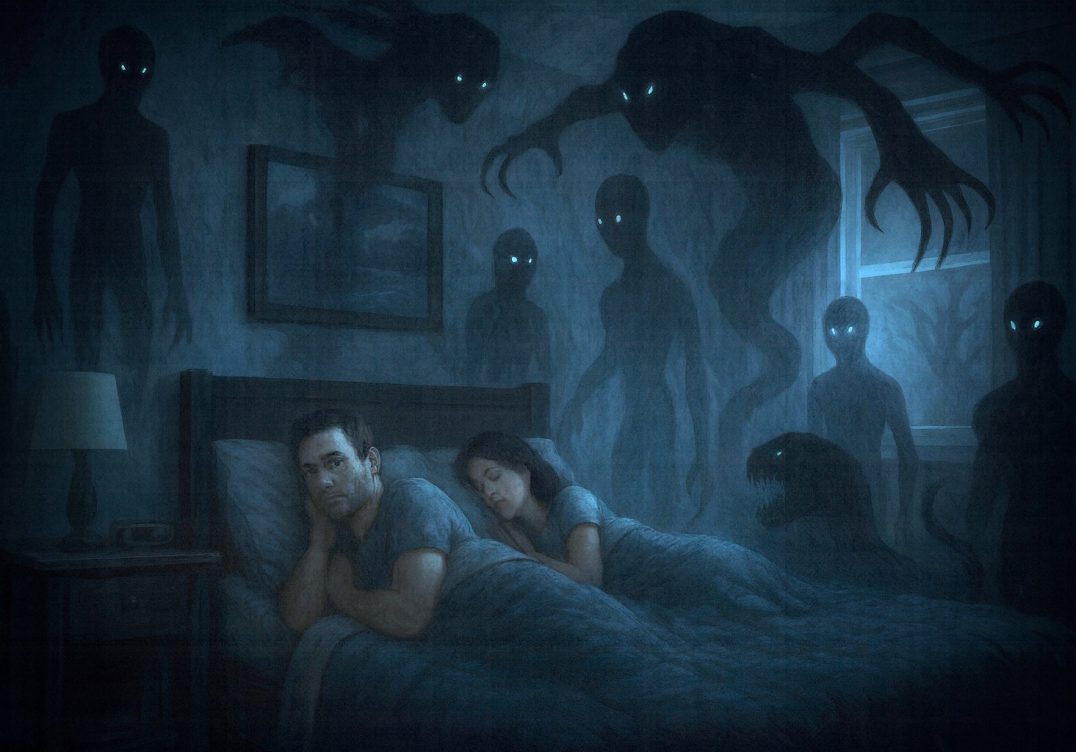
For decades, the search for extraterrestrial life has focused almost entirely on planets, biology, and the narrow band of matter humans can see. But a growing number of researchers argue that this approach may be fundamentally flawed. If most of the universe is made of dark matter and ionized plasma — not the neutral atoms that make up human bodies — then life based on visible matter may be the exception, not the rule.
A recent discussion featuring Dr. Simeon Hein explores this paradigm shift, raising a provocative question: Are we the strange ones in a universe dominated by forms of matter we cannot perceive?
This article examines the scientific context behind that idea and its implications for the UFO/UAP phenomenon.
The Universe Is Mostly Invisible to Us
Modern cosmology estimates that:
- Dark matter makes up roughly 85% of the universe’s mass
- Dark energy accounts for most of the rest
- Ordinary matter — everything humans can see — is only a tiny fraction
Even within that small fraction, up to 99% of atoms in the universe are ionized, not neutral like the atoms in our bodies. This means the “stuff” we’re made of is statistically rare.
If life can emerge in diverse environments, then it is reasonable to consider that life may exist in forms that do not rely on electromagnetic interactions, making them effectively invisible to human senses and instruments.
Could Dark Matter Support Life?
While dark matter remains mysterious, several theoretical possibilities are discussed in scientific literature:
1. Dark matter may have structure
Some models propose that dark matter could:
- clump
- form halos
- interact gravitationally in complex ways
If structure exists, complexity becomes possible.
2. Life doesn’t require carbon — it requires order
Life is fundamentally about:
- pattern formation
- information processing
- self‑organization
If dark matter has any internal dynamics, even weak ones, it could theoretically support non‑baryonic ecosystems.
3. Such life would be undetectable
Because dark matter does not interact with light, any organism made of it would:
- pass through walls
- be invisible
- leave no electromagnetic signature
This aligns with certain characteristics reported in UAP encounters.
Humans as the “Aliens”
One of the most striking ideas raised in the discussion is the inversion of the usual extraterrestrial question.
Instead of asking, “Why don’t we see alien life?”
we might ask, “Why would alien life look like us at all?”
If the universe is overwhelmingly composed of matter we cannot detect, then visible, carbon‑based life may be the anomaly. Humans may be the rare, exotic species in a cosmos dominated by non‑visible forms of existence.
This reframing opens new avenues for interpreting anomalous aerial phenomena. As we know, mainstream religions including gnostic traditions teach that man has “fallen into matter” and is in a sort of sleeping state, awaiting reintegration into the “divine” or “heaven”. Could our current state of being act as a sort of exiled layer of reality? Does humanity currently find itself in what is commonly described as the lowest form of reality, cut off from the higher realms of existence?
Implications for UFO/UAP Research
If non‑baryonic life exists, it could explain several long‑standing mysteries:
1. Sudden appearances and disappearances
Entities not bound by electromagnetic interaction could:
- phase in and out of visibility
- move through solid objects
- appear to violate physics
2. Lack of physical evidence
Dark matter organisms would not leave:
- heat signatures
- radar returns
- conventional traces
3. Consciousness‑based interactions
Some researchers, including Dr. Hein, explore whether consciousness may not be strictly tied to physical matter. If so, interactions with non‑physical or non‑baryonic entities could occur under altered states of perception.
While speculative, these ideas offer a framework that matches certain witness reports more closely than traditional extraterrestrial models.
A New Frontier for MUFON Investigators
For MUFON field researchers, the possibility of dark matter life suggests several investigative shifts:
- Broader data collection: not just electromagnetic signatures
- Attention to witness perception: how humans interface with non‑visible phenomena
- Openness to non‑physical hypotheses: without abandoning scientific rigor
- Cross‑disciplinary collaboration: astrophysics, plasma physics, consciousness studies
The goal is not to replace existing models but to expand them. The “dark matter monsters” concept is not a claim of proof — it is a challenge to our assumptions. If the universe is built mostly from matter we cannot see, then the search for extraterrestrial life must evolve beyond the narrow slice of reality accessible to human senses.
Whether or not dark matter supports life, the idea pushes the UFO/UAP community toward a more expansive, scientifically grounded understanding of what might be sharing the cosmos with us.
Guidelines for MUFON Field Investigators: Approaching Possible Dark Matter Entities or Non‑Baryonic Constructs
Introduction
While dark matter remains undetected by conventional instruments, its gravitational influence is well‑established in astrophysics. If non‑baryonic life or technology exists, it would not interact with light, heat, or electromagnetic fields in the ways investigators are trained to expect. This guide outlines practical, scientifically grounded methods for documenting anomalies that may align with non‑baryonic phenomena — without assuming their nature or origin.
1. Look for Gravitational or Inertial Anomalies
Dark matter interacts through gravity, not electromagnetism.
This means investigators should pay attention to:
Potential Indicators
- Sudden shifts in weight or pressure without visible cause
- Objects moving without apparent force
- Localized “mass effects” (e.g., floorboards creaking, soil compression) with no visible source
- Witness reports of feeling “pulled,” “compressed,” or “tilted” in the absence of wind or vibration
Investigator Action
These effects are subtle — but they are measurable and reportable.
- Document environmental conditions immediately
- Note any physical displacement of objects
- Record witness descriptions of bodily sensations
2. Monitor for Electromagnetic Silence, Not Disturbance
Traditional UAP encounters often involve EM interference. A dark‑matter‑based presence would do the opposite:
Potential Indicators
- Complete lack of EM disturbance where one would normally expect it
- Cameras, radios, and sensors functioning perfectly during a high‑strangeness event
- A “dead zone” of activity where nothing reacts at all
Investigator Action
Silence can be as meaningful as disruption.
- Note the absence of interference
- Compare with baseline readings from the same location
- Document any unusual consistency in electronics during the event
3. Observe Light Behavior — Especially the Lack of It
Dark matter does not emit, reflect, or absorb light.
Potential Indicators
- Witnesses describing “a shape I could feel but not see”
- Shadows behaving inconsistently with visible objects
- Light bending, dimming, or warping around empty space
- Stars or distant lights briefly occluded by “nothing”
Investigator Action
Even if nothing is visible, the environment may reveal the presence.
- Photograph the area from multiple angles
- Record witness sketches or descriptions
- Document any light distortion or occlusion patterns
4. Track Thermal Anomalies
Dark matter does not produce heat.
Potential Indicators
- Cold spots with no physical explanation
- Sudden drops in temperature without airflow
- Thermal cameras showing “voids” or missing regions
Investigator Action
A thermal void is a legitimate data point.
- Use thermal imaging when available
- Compare readings before and after the event
- Document the shape and duration of cold zones
5. Evaluate Witness Perception Carefully
If an entity does not interact with light, this should not be dismissed. Witnesses may perceive it through:
- pressure
- intuition
- motion in peripheral vision
- emotional or cognitive impressions
- sudden awareness of “presence”
Investigator Action
Human perception may be the first detection tool.
- Ask witnesses to describe how they perceived the presence
- Note non‑visual sensory details
- Document any patterns across multiple witnesses
6. Consider the Possibility of Constructed Non‑Baryonic Objects
If an advanced civilization can manipulate dark matter, investigators might encounter:
Potential Indicators
- Geometric gravitational effects
- Repeating patterns of mass displacement
- Structured cold zones
- Symmetrical occlusions of starlight
- Objects that appear to “phase” through matter
Investigator Action
Patterns imply engineering.
- Map the spatial pattern
- Look for symmetry or repetition
- Document any interaction with physical objects
7. Maintain Scientific Neutrality
MUFON investigators should avoid premature conclusions.
Best Practices
- Treat all anomalies as data, not proof
- Avoid labeling events as “dark matter”
- Focus on documenting measurable effects
- Use standardized MUFON reporting protocols
The goal is to expand the investigative toolkit, not redefine the phenomenon.
Conclusion
While dark matter remains invisible to conventional instruments, its gravitational influence provides a legitimate scientific basis for considering non‑baryonic phenomena in UAP investigations. By documenting subtle environmental anomalies — gravitational, thermal, perceptual, and structural — MUFON investigators can contribute valuable data to a frontier of research that may redefine our understanding of life and technology in the universe.


Comments