

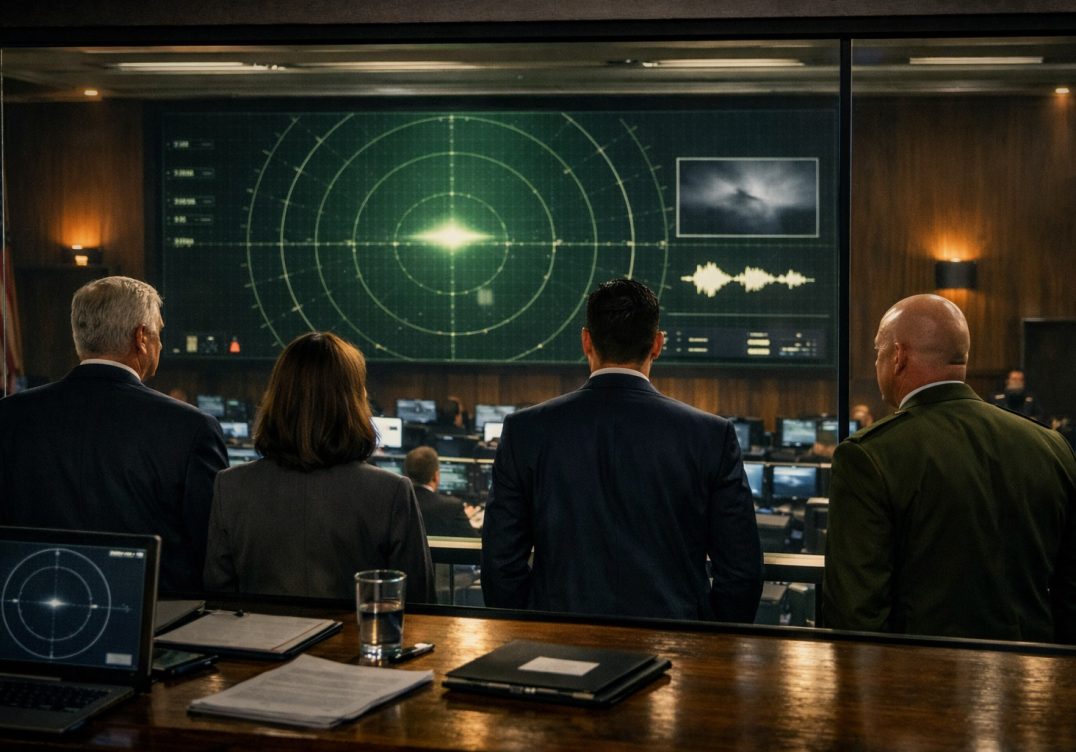
Many are saying that UFO and extraterrestrial life disclosure began on May 8th, 2026, spearheaded by President Trump’s mandate for transparency from all government agencies including the Department of War (DoD), the Department of State, the FBI, and NASA. The files were originally dropped on the DoW site war.gov/ufo.
Many are describing this initial effort as a “nothing-burger,” but that may be a little harsh considering this is merely the first round with more to come weekly. Perhaps the uninitiated need a little more time to swallow this horse pill one dose at a time; we can only speculate why the initial content was somewhat lackluster but nevertheless expected.
According to official sources these releases are rolling, provisional, and still undergoing security review. Some documents are unresolved cases with insufficient data — and may be pulled for quality control. The DoW has stated on its own site that the transparency effort requires “the review of tens of millions of records, many existing only on paper, spanning many decades.”
Sources also confirm that the files are being posted before full analysis, and that the archive is being actively updated, corrected, and re‑curated as agencies continue their review. This creates a situation where some documents appear, then vanish, then reappear in altered or redacted form. That seems a little suspicious to say the least.
The original file dump was quickly consumed and reorganized across various other .com sites with user-friendly interfaces like showmeufos.com. Here you can see the original number of documents is significantly greater than its source while the public watched file counts from the source dwindle in real-time.
What’s new in This Initial Dump?
1. Centralization of multi‑agency files into one public portal
For the first time, the Pentagon, FBI, NASA, ODNI, DOE, and others are funneling declassified UAP material into a single public-facing archive. This is new — historically, these agencies kept their UAP records siloed.
2. The PURSUE system (Presidential Unsealing and Reporting System for UAP Encounters)
This is a newly created interagency mechanism specifically designed to continuously declassify and publish UAP files. It’s not a one‑off dump — it’s a pipeline.
3. Rolling releases every few weeks
The Pentagon explicitly says this is the first tranche of many, with tens of millions of records still under review. That scale and cadence is unprecedented.
4. Acknowledgment that many cases remain unresolved
The government is openly stating that a large portion of these cases are unresolved anomalies with insufficient data for explanation. That’s more candid than past language, which leaned heavily on “likely balloons/drones.”
What’s not new…
1. No confirmation of extraterrestrial craft or bodies Nothing in this dump verifies non-human technology, crash retrievals, or biological evidence. The files are mostly sightings, photos, and reports — many of which resemble previously leaked or FOIA’d material.
2. No analytic conclusions The Pentagon stresses that most files “have not yet been analyzed for resolution.” Translation: raw data, no answers.
3. Many images and videos are familiar Infrared blobs, fast-moving specks, ambiguous shapes — the same flavor of material we’ve seen since 2017.
4. No major historical bombshells No Roswell files, no crash retrieval program documents, no reverse-engineering evidence. This is not the “vault” people hoped for.
The Real Significance
The shift isn’t in the content — it’s in the infrastructure and political posture.
The administration is committing to maximum transparency as a stated policy. Agencies are now in lockstep on UAP disclosure instead of stonewalling each other. The public now has unfettered access to declassified UAP files without FOIA battles. This is the first time the U.S. government has built a permanent, public, multi-agency disclosure pipeline.
A Fragmented Disclosure Landscape
Political pressure, scientific mobilization, and civilian sighting clusters are accelerating simultaneously in 2026. These fronts are generating unprecedented volumes of data — yet none of them are integrated. MUFON now occupies a critical role as the only organization capable of correlating political disclosures, scientific findings, and civilian reports into a unified investigative framework.
The 2026 disclosure environment is no longer defined by a single source of information. Instead, it has split into three independent fronts. All are producing meaningful data, but each operates in isolation. This fragmentation creates gaps in understanding that directly impacts investigators, researchers, and the public. MUFON’s role is shifting accordingly and the organization is no longer just a collector of reports — it is becoming the integrator of the disclosure era.
The Political Front: Government Under Mandated Transparency
The administration’s 90‑day UAP file release directive has placed intelligence agencies under direct scrutiny. Congressional committees have increased oversight on historical UAP programs, AARO’s case backlog, classified sensor data and interagency communication failures.
These disclosures are significant, but they are partial. They provide fragments without context, often lacking witness‑level detail or long‑term pattern analysis.
Relevance to MUFON: Political releases frequently reference events that correlate with MUFON’s historical case files. Investigators can use these disclosures to validate, compare, or expand existing data.
The Scientific Front: Institutions Re‑Tooling for Anomaly Detection
NASA’s expanded UAP research initiative and AARO’s growing case load signal a shift toward structured scientific engagement. The focus is moving from explanation to instrumentation, including multi‑sensor data collection, atmospheric modeling, flight‑characteristic analysis, and cross‑agency data standardization.
However, scientific institutions operate slowly and cautiously. Their findings often lack the immediacy and granularity needed for field investigation.
Relevance to MUFON: Scientific reports can be translated into investigator‑ready frameworks, allowing field teams to test new hypotheses against decades of MUFON data.
The Civilian Front: Rising Multi‑Witness Clusters
Civilian reporting has surged across the United States, with notable clusters including:
- Wisconsin: 40+ reports within two hours
- Vandenberg region: 28 independent reports over three nights
- Colorado, Utah, Arizona: increased triangle and flare‑type sightings
These events are not isolated anomalies; they represent behavioral patterns consistent with historical UAP waves.
Relevance to MUFON: Civilian clusters provide real‑time data that can be cross‑referenced with historical patterns, sensor reports, and political disclosures.
The Missing Integration Layer
Despite the volume of information emerging from all three fronts, no institution is synthesizing these data streams. The result is a fragmented narrative. Political disclosures lack scientific interpretation. Scientific findings lack witness‑level detail and civilian reports lack institutional context. This is the gap MUFON is uniquely positioned to fill. MUFON becomes the Fourth Front when it acts as the integrator across all domains.
A. Linking Political Releases to Field Data
Declassified files often reference events that align with MUFON’s historical case logs. Investigators can use these connections to validate timelines, behaviors, and flight characteristics.
B. Translating Scientific Findings into Field Application
Scientific insights can be operationalized into investigative protocols, improving case classification and pattern recognition.
C. Mapping Civilian Clusters Against Historical Waves
Modern clusters can be compared to:
- Phoenix Lights
- Hudson Valley wave
- Belgian triangle wave
This continuity is something MUFON can help provide.
What Investigators Should Expect in 2026
Based on current trends, MUFON investigators should prepare for:
- Increased multi‑witness clusters
- More partial or redacted disclosures
- Greater opportunities for scientific collaboration
- Higher public demand for clarity
- More cross‑border sighting correlations
2026 is not the year disclosure “arrives.” It is the year disclosure diverges — and MUFON becomes the organization that reconnects the threads. The disclosure landscape is evolving faster than any single institution can manage. Political bodies reveal fragments, while scientific institutions reveal mechanisms and civilian witnesses reveal behavior.


Comments