

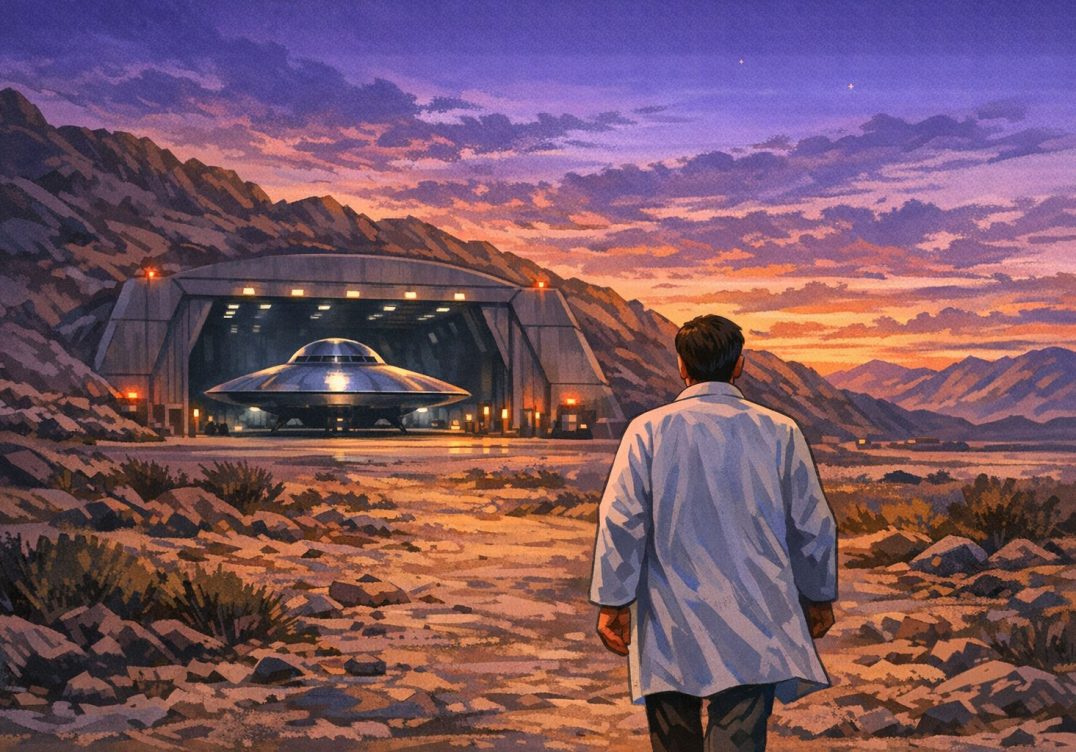
When Bob Lazar sat down with Joe Rogan again in 2026, joined by Luigi Vendittelli, it didn’t feel like a publicity tour. It felt like a reopening of a case file — one that has sat unresolved for more than thirty years. Lazar has never behaved like a man seeking attention. If anything, he has spent most of his adult life trying to outrun the consequences of a story he never wanted to tell. Lazar claims he worked as a propulsions engineer at a secret and remote Nevada desert government installation where he was to help reverse engineer UFO technology from multiple craft obtained through unknown methods. Yet every time he resurfaces, the same questions return with him, sharper than before.
According to Bob Lazar’s 1989 account, S‑4 (Site Four) was a classified underground installation built into the slope of Papoose Mountain at Papoose Lake, Nevada, roughly 12–13 miles south of Area 51 (Groom Lake) en.ikwipedia.org. Lazar described it as being off the eastern shore of Papoose Dry Lake, about 900 feet above the lakebed, where the desert floor meets the hillside en.ikwipedia.org. He claimed the facility had nine hangar bays with sand‑coated doors designed to blend into the mountain, and that it was located in the Emigrant Valley area
The new interview, paired with the documentary S4: The Bob Lazar Story, forms a kind of dual deposition. One is conversational and unguarded; the other is structured and archival. Together, they reveal not only what Lazar claims happened at S4, but why he says he broke his silence in the first place — and why he risked taking a piece of Element 115 home.
These motivations are often glossed over in summaries of Lazar’s testimony, but they are central to understanding the man and the controversy that surrounds him.
Why Lazar Says He Went Public
According to Lazar, the decision to go public was not ideological, not financial, and not driven by any desire to expose government wrongdoing. It was driven by fear — specifically, fear for his own safety.
In both the documentary and the 2026 interview, Lazar describes a shift in the atmosphere at S4 after he began asking questions about the program’s secrecy and the limits of his access. He claims that security personnel became more aggressive, that his movements were scrutinized more closely, and that he was subjected to what he describes as “interrogation‑style” interviews about his personal life.
The breaking point, he says, came when he realized he was being followed outside of work. He interpreted this as a sign that his position at S4 was unstable — and that if he were removed from the program, he might not simply be fired. He feared he might be silenced permanently.
Going public, in his view, was a form of insurance. If the story was already out, there would be no reason to make him disappear. Whether one believes this rationale or not, it is consistent with his behavior: he did not seek fame, he did not seek money, and he has spent decades trying to minimize his public exposure.
Why He Claims He Took Element 115
The most controversial part of Lazar’s story — even more than the craft itself — is his claim that he removed a small quantity of Element 115 from S4.
In the documentary, Lazar explains that he took the material not as a souvenir, but as leverage. He believed that if he possessed something the government desperately wanted back, it would make him too valuable to eliminate. In his mind, the material was a life‑preserver.
He also suggests that he wanted to prove the existence of the program if necessary. If he were ever forced to defend his claims, the material could serve as physical evidence. He never produced it publicly, and its current status remains unknown. But the logic he describes — fear, leverage, survival — aligns with the same motivations that pushed him to speak out.
Whether this explanation is credible is a separate question. What matters for investigative purposes is that it fits the internal consistency of his narrative: a man who believed he was in danger, who acted irrationally under pressure, and who has spent the rest of his life dealing with the fallout.
The 2026 Interview and the Documentary: A Consistent but Unverified Record
What stands out in the 2026 Rogan interview is not new information, but Lazar’s demeanor. He appears tired, almost resigned, as if the weight of decades of scrutiny has settled into his posture. He does not embellish his story. He does not modernize it to match current scientific trends. He simply repeats what he has always said.
The documentary reinforces this impression. Archival footage shows a younger Lazar describing the same craft geometry, the same propulsion principles, the same security procedures. The film does not resolve the disputes over his academic records or the absence of official documentation linking him to S4. But it does confirm that he worked at Los Alamos in some capacity — a fact supported by a 1982 phone directory listing him among the technical staff.
The Aerial Photograph: A Persistent Anomaly
And then there is the photograph — the one piece of physical evidence that refuses to disappear.
A high‑resolution aerial image of the Papoose Lake region, when subjected to forensic photographic enhancement, reveals geometric anomalies in the hillside: straight‑edged recesses, uniform shadowing, and angular cuts that do not match natural erosion patterns. To some analysts, these features resemble the very hangar doors Lazar described in 1989 — doors built into the hillside, flush with the terrain, designed to conceal craft from overhead observation.
The photograph is not proof. It cannot tell us what lies behind those shapes. But it does undermine one of the most persistent criticisms of Lazar’s story: the claim that nothing exists at the location he identified. The image shows that something is there — and that “something” aligns uncannily with his original description.
The Lazar Paradox
This is the central tension of the Lazar case. The scientific contradictions remain unresolved. No stable isotope of Element 115 has been produced. No known propulsion system matches his description. No official documentation confirms the existence of S4 as he portrays it.
Yet his story has not drifted. He has not profited from it. He has not sought attention. He has not attempted to update his claims to match new scientific developments. His motivations — fear, self‑preservation, and a desire to protect himself by making the story public — have remained unchanged.
The 2026 interview does not solve the Lazar paradox. The documentary does not solve it. The aerial photograph does not solve it. But together, they form a triangulation: three independent sources that, when overlaid, create a shape that is difficult to ignore.
The Lazar case is not confirmed. It is not debunked. It is suspended — a question waiting for the piece of evidence that will finally tip the scale.
Until that day comes, the photograph remains on the table. The interview remains on record. The documentary remains in circulation. And Lazar, whether he wants the role or not, remains one of the most enduring and enigmatic figures in the history of UFO investigation.


Comments