

On June 11, 2023, former U.S. intelligence officer David Grusch — who previously served with the National Reconnaissance Office and the Global Intelligence Center — appeared on NewsNation to discuss what he described as a “reported” UFO crash in northern Italy.
According to Grusch, the event took place near Magenta in 1933 and may represent the earliest known recovery of a non-human craft by government authorities. He explained that his knowledge came from classified briefings and direct testimony from individuals tied to a broader American crash-retrieval program.
Seven weeks later, Grusch repeated these claims under oath before the House Oversight Committee’s Subcommittee on National Security, the Border, and Foreign Affairs. His testimony, delivered on July 26, 2023, once again referenced “the Magenta incident,” and his earlier NewsNation interview was formally entered into the Congressional record.
Historical Background
Although Grusch’s remarks reignited global interest, the Magenta story itself is not new. Italian researchers have been examining the case since the 1990s. Reports describe a disc- or bell-shaped craft that either crashed or was forced down roughly 25 kilometers west of Milan in mid-1933. Dates most often cited are June 13, though some accounts mention April 11.
Benito Mussolini, then Italy’s Fascist leader, allegedly ordered the wreckage secured under strict secrecy, fearing it might be advanced foreign technology. A directive reportedly threatened journalists with arrest should they attempt to publish details.
A covert investigative body known as Gabinetto RS/33 (“Special Research, 1933”) was said to have been formed to study the object. Nobel Prize–winning radio pioneer Guglielmo Marconi was purportedly placed in charge, reporting directly to Mussolini. The group’s mission: analyze the craft, its materials, and related sightings.
Accounts further claim the wreckage was stored at the SIAI-Marchetti aircraft facility in Vergiate until 1944, when U.S. intelligence operatives from the Office of Strategic Services allegedly seized the remains and transported them to America.
The RS/33 Cabinet Papers
The foundation of the Magenta narrative rests on a series of documents known as the “RS/33 Cabinet papers.” Between 1996 and 2000, Italian researchers Roberto Pinotti and Alfredo Lissoni received these materials anonymously from a source calling himself “Mr. X.” The package contained original and photocopied documents dating to the 1930s.
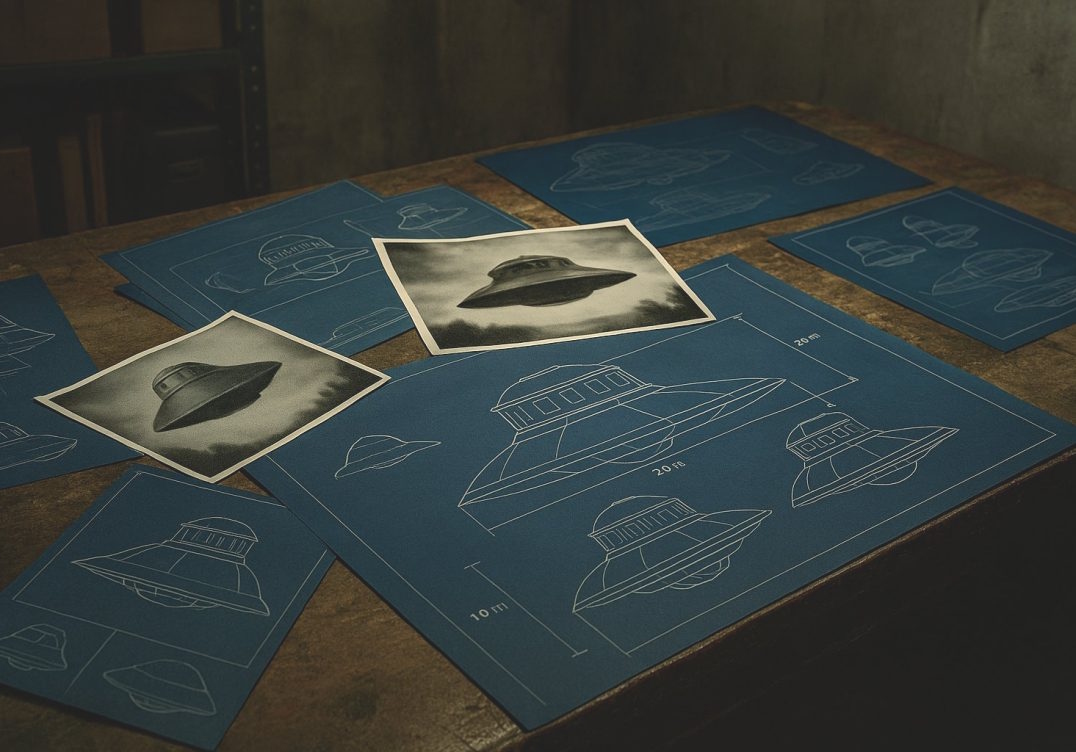
While mainstream Italian newspapers largely ignored the leak, Pinotti’s publication UFO Notiziario devoted extensive coverage to the papers. The documents included telegram drafts signed in Mussolini’s name, a memorandum describing a metallic disc with portholes, sketches of the craft, and repeated references to RS/33.
The batches of material contained:
- Letters on official Senato del Regno stationery dated June 13, 1933
- “Top secret” telegrams from Milan’s Telegraphic Office
- A handwritten memo with a sketch of a disc- or cigar-shaped craft seen over Mestre (1936)
- A Stefani-agency telegram ordering “absolute secrecy” regarding unidentified aircraft
- Invitations to private RS/33 meetings at Villa Torlonia
- A one-million-lire banknote marked “RS/33 funds”
Forensic testing reportedly confirmed the ink and paper dated to the 1930s, though full lab reports have never been released and independent verification remains absent.
Researchers and Publicity
Pinotti, founder of Centro Ufologico Nazionale (CUN), first publicized the documents in 1996 and presented them at the 2000 World UFO Symposium in San Marino. Lissoni, a journalist and archivist, co-presented and later authored UFO Crash at Vergiate. Together, they translated and contextualized the materials, making them accessible to international audiences.
Skepticism and Controversy
Skeptics point out that no official Italian government archives reference RS/33, leaving its existence unverified. In 2019, researcher William Brophy added sensational claims of recovered “Nordic extraterrestrial beings” and a bell-shaped craft, though these assertions are widely regarded as speculative and unsupported by the original documents.
Presence in UFO Literature
Despite its obscurity in English-language circles, the Magenta case has appeared in European UFO writings. Timothy Good referenced it in his 1996 book Beyond Top Secret. Brophy wrote about it in Filer’s Files in 2019 and claimed to present at a San Marino symposium. More recently, former Pentagon AATIP official Lue Elizondo acknowledged awareness of the Magenta reports during a 2025 conference.
Conclusion
The alleged 1933 Magenta crash remains one of the more intriguing — yet unverified — episodes in UFO history. While the narrative fits within broader crash-retrieval themes, its credibility is weakened by the absence of corroborating government records and limited access to original documentation. Still, the fact that both David Grusch and Lue Elizondo have cited the case in official contexts lends it a measure of weight within ongoing discussions of unidentified anomalous phenomena.

