

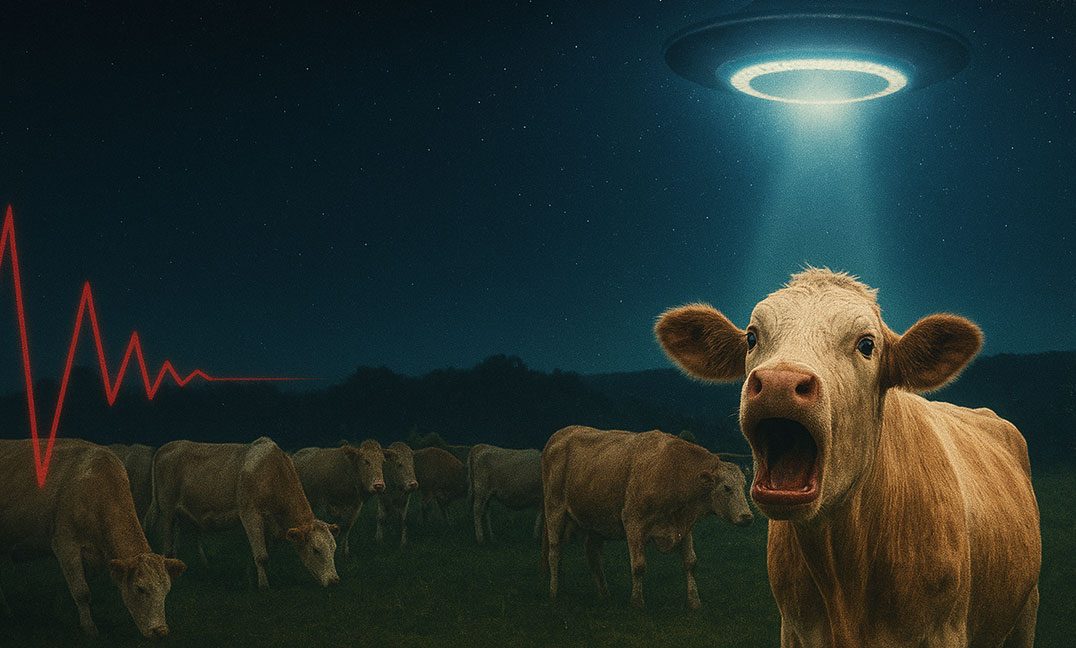
The video “Magnetic Anomaly & ‘Screaming’ Cows: UFO-Sense Detects Guffey Event” presents an unsettling story from the quiet region of Guffey, Colorado. According to the account, a series of unusual magnetic fluctuations were detected during the early morning hours, coinciding with a burst of disturbing animal behavior from a nearby herd of cattle. Those vocalizations — described as intense, almost “screaming” cries — became the centerpiece of speculation around what may have unfolded in the area.
The video suggests that instruments tuned to identify magnetic disturbances captured sudden spikes at roughly the same time the cattle reacted. For some viewers, that overlap hints at something more than a natural incident. Within UFO-focused communities, this combination of environmental disruption and animal distress often raises the possibility of an unidentified aerial or energetic event. The Guffey case quickly joined that conversation.
The idea of animals responding to bizarre stimuli is deeply rooted in UFO lore. Investigators who have explored anomalous cases in Colorado, Utah, and other parts of the Mountain West frequently note that livestock can act as early warning systems. Reports from previous decades include stories of sudden agitation, mass movement, or strange vocalizing among herds moments before witnesses claim to have seen lights in the sky or experienced unusual atmospheric conditions. The Guffey incident fits cleanly into that pattern, at least from a narrative standpoint.
However, interpreting the event as something extraordinary requires caution. No independent scientific verification has yet confirmed the magnetic anomaly reported in the video, nor have researchers analyzed the cattle’s behavior with controlled evidence. Animals can be highly reactive to a wide range of normal stimuli: predators, weather shifts, electrical storms, environmental noise, or internal herd stress. Distress calls may simply have been amplified by the quiet rural setting — or by observers primed to see the unusual. In a region rich with UFO stories, even ordinary events can take on a mythical dimension when presented through the right lens.
To legitimately investigate the Guffey claims, much more data would be needed. Continuous scientific monitoring of the magnetic field, multi-angle audio and video recordings of the herd, and environmental logs from meteorological and seismic sources would help build a clearer picture. Without those elements, the story remains compelling but unverified. A proper study could reveal whether the anomaly was a real geophysical event, an equipment glitch, or perhaps just an intriguing coincidence.
Despite the uncertainties, the Guffey narrative highlights how quickly folklore, technology, and unexplained events can intersect. It also underscores how little we understand about the natural responses of animals to environmental shifts — whether mundane or unusual. Even if the phenomenon turns out to be misinterpreted, stories like this remind us of the mysteries that emerge at the edges of modern scientific knowledge, particularly in remote regions where monitoring is sparse.
For now, the Guffey Event lives in the space between rural legend and investigative curiosity: a moment where magnetic readings, frightened cattle, and the possibility of the unknown briefly came together, leaving behind more questions than answers.

John Craig, founder of UFO-Track.com, is a scientist, engineer, and mathematician on a mission to prove UFOs exist. He and his wife EJ—both lifelong skywatchers—develop tools like the UFO-Sense detector, which alerts members to local anomalies. Together, they lead a growing network of civilian skywatchers documenting the unexplained.